 Leta
Belts and chain
Routing > Belt lays a belt or a roller chain round pulleys or sprockets clicked in the order it runs round them, works out its length, and makes its part beside the assembly. The pulleys then turn with it, and an open belt drives the carriage its ends are clamped to.
Laying a belt
Pulleys are clicked in the order the belt runs round them, and the belt is laid on their pitch lines as they are picked. It is a part file of its own beside the assembly, made again whenever the pulleys move, so drawings, STEP, the bill of materials, mass and interference take it like any other part.
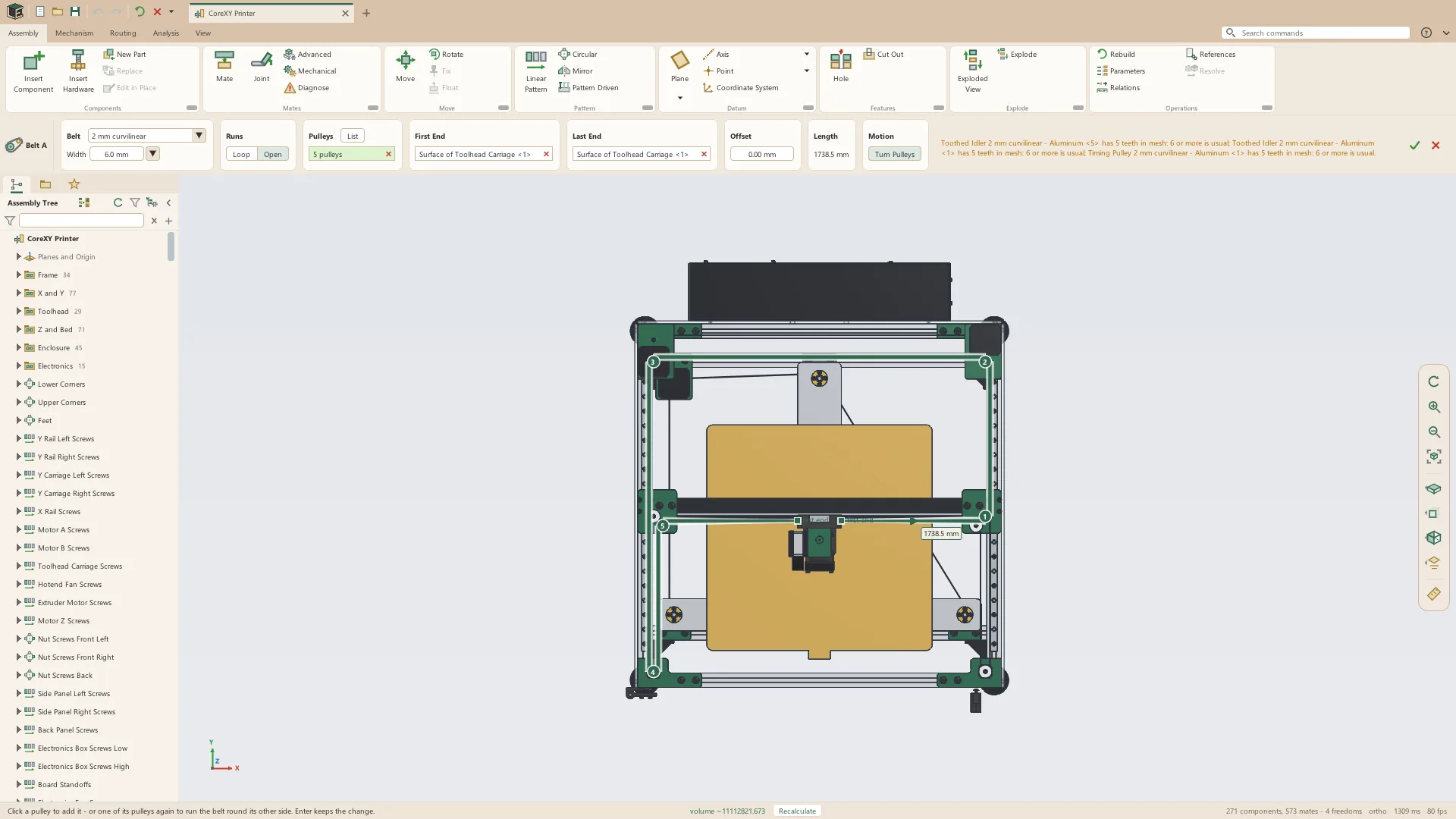
- A pulley picked by the round surface the belt runs on, or a circular edge of it
- A hardware library pulley or idler clicked anywhere, its flange or its hub, carries the belt on its teeth
- The way round each pulley taken from the order of the picks, and an idler pressing on the belt's back found by itself
- A pulley clicked again runs the belt round its other side
- The belt's plane square to the first pulley's axis, its middle moved along that axis by Offset
- Any number of pulleys, their axes parallel
- Named Belt1, Belt2 and so on, its part saved beside the assembly once the assembly has been saved
- Edited again by a double-click on its row in the tree, or Edit Belt on its menu
Belt kinds and pitches
Timing belts come in eight pitches, each in the widths it is commonly sold in, beside flat and round belts. A timing belt is drawn as a smooth band, and its length and teeth are counted along its pitch line.
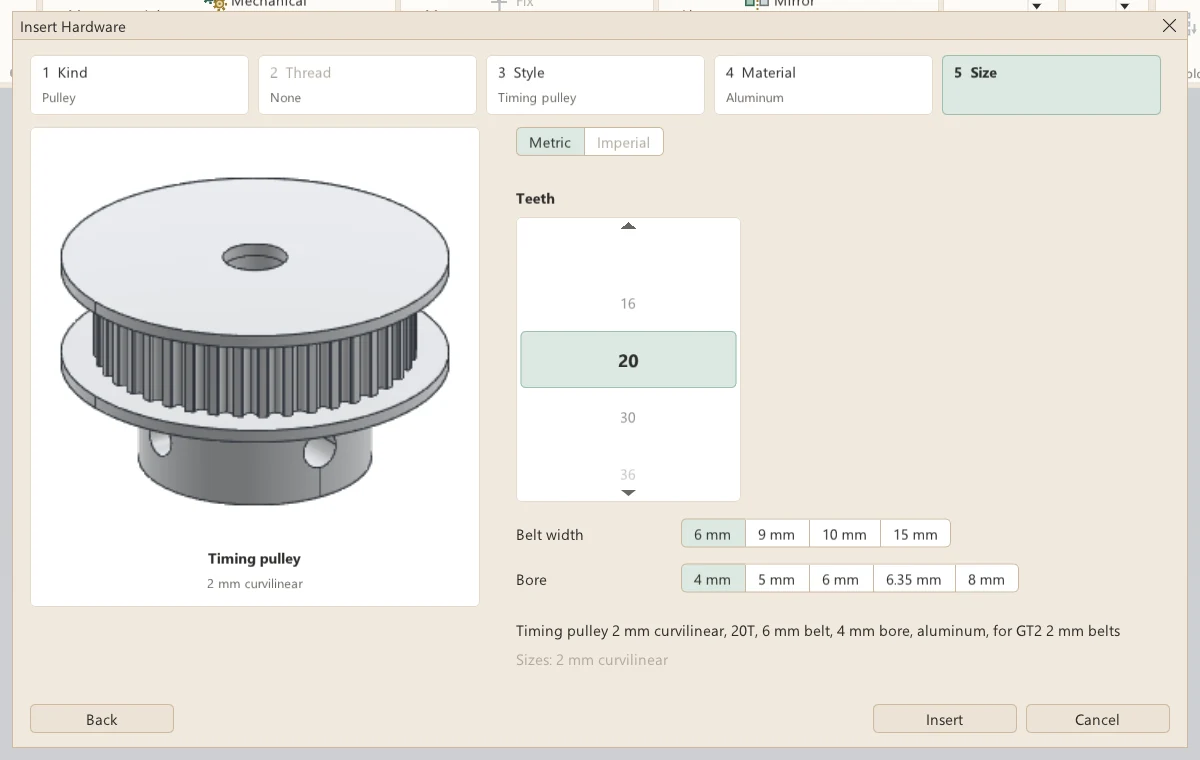
- 2 mm curvilinear, 6 to 12 mm wide
- 3 mm curvilinear and 3 mm round tooth, 6 to 15 mm wide
- 5 mm round tooth, 9 to 25 mm wide
- MXL (0.080 in) and XL (0.200 in), 3.2 to 9.5 mm wide
- T2.5 and T5, 4 to 25 mm wide
- Flat belts 1, 1.5, 2 and 3 mm thick, 10 to 50 mm wide
- Round belts 2 to 10 mm across
- Any width or diameter typed, as a number or an expression
Open belts and CoreXY
An open belt has its ends clamped to a part, as a 3D printer's belts are clamped to its toolhead. Dragging that part turns the pulleys, and turning a pulley moves the part.
- Runs: Loop, or Open with a First End and a Last End
- Each end clamped at a face where it is clicked, at an edge or at a point
- On a CoreXY machine each motor turns by the sum or the difference of the head's moves
- One motor turned alone moves the head along a diagonal
- The sample printer's two belts run on two levels, one above the other, each round its own pulleys
- A pulley that cannot turn is left out of the coupling and named
Length and teeth
The belt's length is worked out as the pulleys are picked, with a closed timing belt's tooth count beside it. The belt's part carries those numbers as parameters, for drawings and the bill of materials.
- Length along the pitch line, all the way round or from clamp to clamp
- A closed timing belt's teeth, and the lengths of the belts with a whole number of teeth either side
- The pulley list: each pulley's diameter, its teeth, how far round it the belt goes, and the teeth in mesh
- A pulley found to be toothed by its teeth fitting the belt's pitch; a smooth one carries the belt on its tips or on its back
- Notes when fewer than six teeth are in mesh, or the belt runs past the end of a pulley's surface
- A span that cannot be laid between two pulleys names the two
- Parameters BELT, WIDTH or DIAMETER, LENGTH, TEETH and PART_NUMBER in the belt's part
- Rubber, or polyurethane for a round belt, weighted to about what the real belt weighs
Roller chain
The same Belt command lays single-strand roller chain round sprockets, in 14 sizes. A chain always runs in a loop, and its part is every roller, pin and plate of it.
- ANSI 25, 35, 40, 41, 50 and 60
- 219 kart chain, 420, 428 and 520
- ISO 06B, 08B, 10B and 12B
- Pitch, roller, width between the inner plates and pin from typical published dimensions
- The pitch shown in the strip, the roller, inner width and width over the pins in its tooltip
- A roller and a pin at every pitch, inner and outer plates on alternate links
- Steel, its mass the chain's own metal
- Parameters CHAIN, PITCH, LINKS, LENGTH and PART_NUMBER, such as "428 chain, 64 links"
Sprockets, links and slack
A sprocket is found by the seats between its teeth, whichever of its faces is picked, so the rollers sit in its teeth wherever it has turned to. The runs between sprockets are laid in whole links, and the slack left over is given.
- A sprocket's teeth and clocking read from its seats on the pitch circle; its bore will do as the pick
- A plain disc's teeth worked out from its tip diameter, with a note that the rollers may not sit in them
- The chain's length: its links times its pitch
- The slack in its straight runs, and how far to move a sprocket to take it up, or how far the chain is short
- Notes for an odd number of links, under 120 degrees of wrap on the smallest sprocket, and teeth standing past the inner plates
- A tensioner on the chain's back carries it under its plates
- The pulley list gives the rollers in each sprocket's teeth
- The hardware library's sprockets, in ten of the chain sizes, have the seats the chain finds
How they drive
A belt or chain is laid with the mates that make its pulleys turn, named after it and made again whenever it is edited. Turning any one of its pulleys or sprockets turns the rest, in a drag or in a motion study.
- Turn Pulleys, on the strip's Motion card, couples the pulleys to the belt
- A loop turns its pulleys together, each by its own pitch radius
- Sprockets turn at their tooth ratio exactly, and the chain is laid again as they turn, its rollers following the teeth
- An open belt turns its pulleys as the part its ends are clamped to moves, and moves that part as they turn
- The belt laid again after every solve, drags included
- Removing the belt's component removes the belt and its mates
- The Belt mate on the Mechanism tab couples pulleys without laying a belt
See it on your own parts
Beta builds go out by email. Say what you design and what you use now.